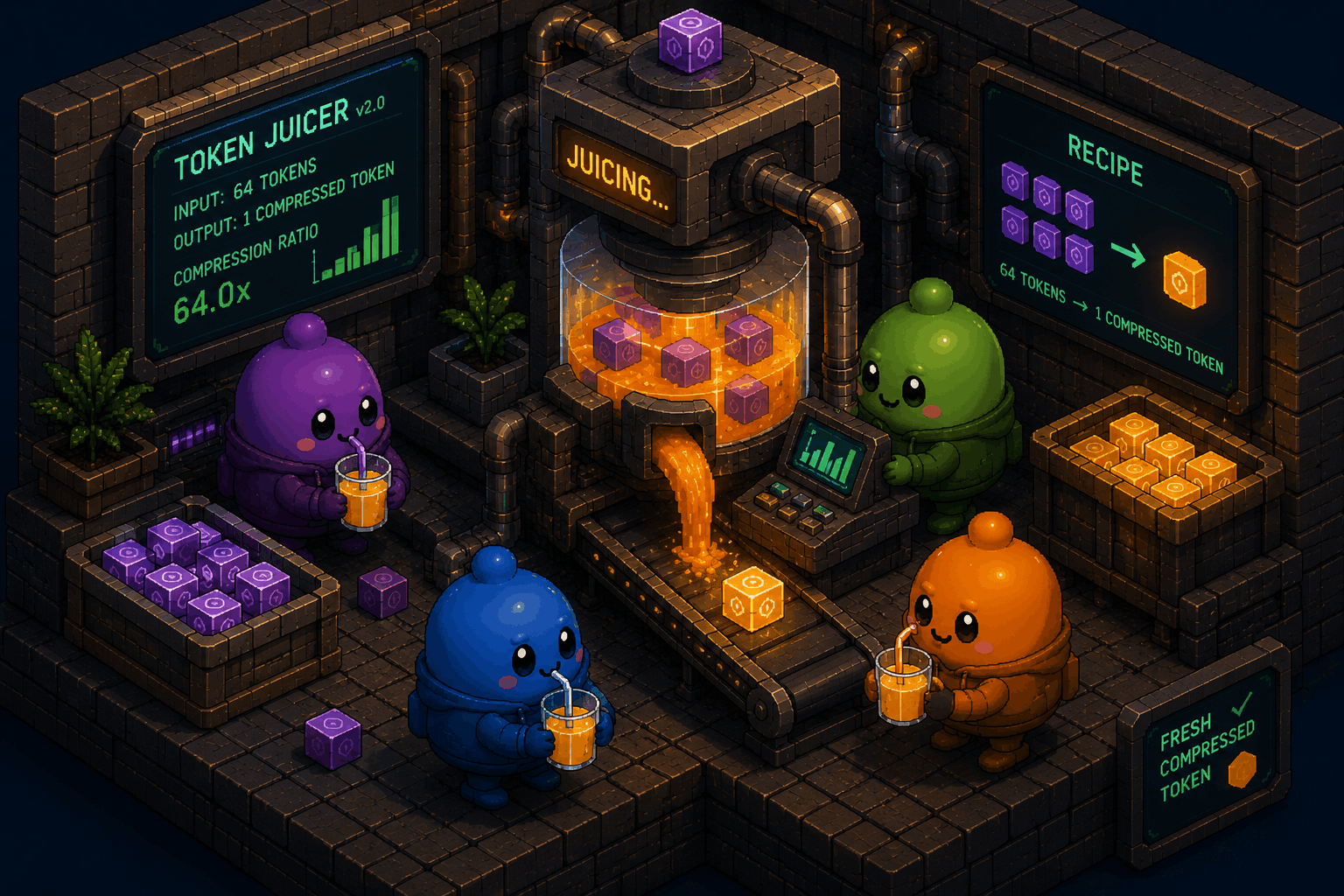


TinyJuice is token compression for terminal-heavy agents. It sits between tool output and model context, turning noisy logs, diffs, JSON, search results, HTML, and source files into compact views that keep the signal visible.
Agents waste context on the same junk over and over: passing test chatter, duplicated JSON keys, huge Docker logs, repetitive grep hits, lockfile diffs, and markup nobody needs to reason about. TinyJuice cuts that noise before it hits the model.
The important part: compacted output stays recoverable. When TinyJuice shows a partial view, it stores the exact original behind a retrieval token instead of silently throwing data away.
Install the CLI:
cargo install tinyjuice --lockedRun one hook installer:
| Logo | Client | Install |
|---|---|---|
 |
Codex CLI | tinyjuice install codex |
 |
Claude Code | tinyjuice install claude-code |
Use tinyjuice update <host> to refresh an installed hook and
tinyjuice uninstall <host> to remove it.
Custom paths, development installs, recovery, and tuning live in docs/agent-hooks/README.md. Interactive installs also ask whether to add optional TinyJuice support commit attribution for agent-created commits.
- More useful context - failures, summaries, changed hunks, matching lines, signatures, and anomalies stay visible.
- Less transcript waste - repeated structure, boilerplate, setup chatter, and markup get collapsed.
- Recoverable partial views - exact originals can be pulled back when a compact view is not enough.
- Agent-ready defaults - command-aware reducers understand common shell, git, cargo, npm, Docker, kubectl, database, cloud, lint, and test output.
- Host-owned policy - OpenHuman and other runtimes decide when compression is full, light, off, or profile-driven.
- Privacy-aware by design - analytics can use metadata, byte counts, latency, status, and strategy labels without requiring raw prompt text.
| Surface | What stays visible |
|---|---|
| JSON | Tables, schema shape, anomaly rows |
| Logs | Errors, warnings, stack traces, summaries |
| Search results | Top matches, file grouping, match counts |
| Diffs | File headers, hunk headers, changed lines |
| Code | Imports, signatures, top-level structure |
| HTML | Readable page text without script and markup noise |
| Plain text | Pass-through unless a host enables an ML callback |
The checked-in benchmark corpus uses 10 real snapshots per category. Pass 1
disables CCR and reports only reductions that are safe without recovery. Pass 2 is the final model-facing result with CCR enabled.
| Category | Cases | Pass 1: no CCR | Pass 2: with CCR | Avg latency |
|---|---|---|---|---|
| Service and Docker logs | 10 | 0.0% | 86.3% | 0.144 ms |
| HTML, RSS, and page snapshots | 10 | 0.0% | 75.3% | 0.167 ms |
| Unified diffs | 10 | 0.0% | 70.0% | 0.150 ms |
| Rust source | 10 | 0.0% | 51.9% | 0.710 ms |
| Search results | 10 | 0.0% | 48.0% | 0.311 ms |
| JSON SmartCrusher | 10 | 0.0% | 19.4% | 0.363 ms |
| Test failure logs | 10 | 0.0% | 14.1% | 0.034 ms |
| Plain text with ML off | 10 | 0.0% | 0.0% | 0.000 ms |
These are local real-snapshot corpus measurements, not production-wide claims. See docs/benchmark and docs/benchmarking.md for the reproducible reports.
The technical docs live in the wiki:
- SDK and Plugin Integration
- Quick Start
- Capabilities
- Architecture
- Router and Compressors
- CCR Recovery
- Rule Engine
- OpenHuman Integration
- Development
- Security and Privacy
TinyJuice is pre-1.0. The CLI, router, command-rule engine, CCR recovery store, content detectors, native compressors, and OpenHuman-style adapter are in place; public API names may still move as host integration hardens.