Stable, reusable, and observable code context infrastructure for AI agents
Hybrid Retrieval · Project Memory · MCP Server · Retrieval Observability




简体中文 · Docs · First Use · Deployment · CLI · MCP
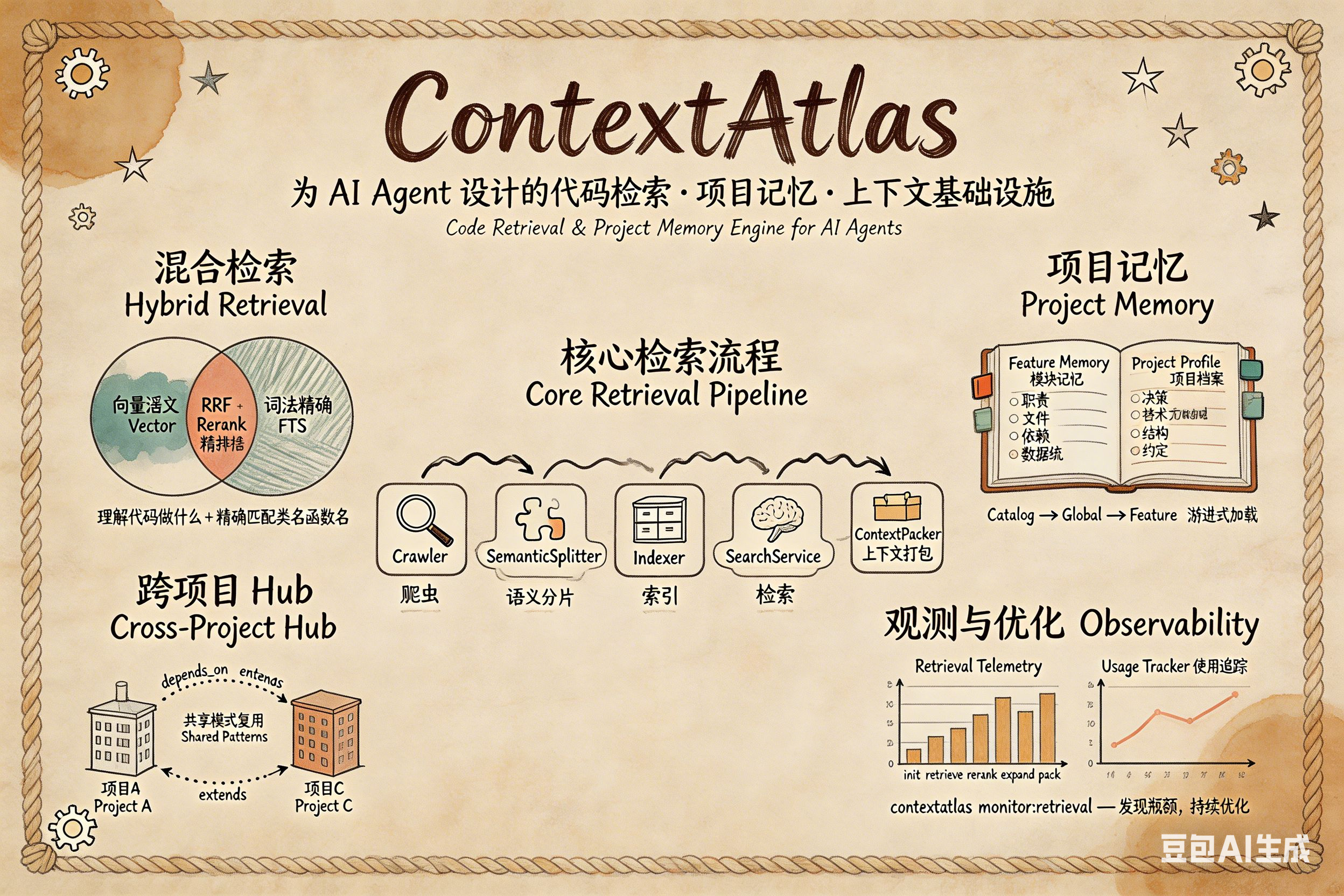
ContextAtlas is an open-source context infrastructure for AI coding agents — providing hybrid code retrieval, project memory, and retrieval observability as a CLI, MCP server, or embeddable library. It combines tree-sitter semantic chunking, LanceDB vector search, SQLite FTS5 full-text search, and token-aware context packing to deliver structured, high-quality code context to tools like Claude Code, Codex, and custom agent workflows.
2026-04-15: added git hook auto-maintenance with--quickhealth check (260x speedup), stale index cleanup CLI, and three-layer hook protection (debounce + quick mode + daily throttle).2026-04-14: extracted 11 Memory MCP tools' business logic to application layer, completing three-layer architecture separation (CLI / MCP adapter → application → domain), and fixed all 31 TypeScript compilation errors.2026-04-10:codebase-retrievalnow includes the lightweight direct graph summary by default, with MCP metadata, tests, and changelog docs updated in sync.2026-04-09: added churn / cost-aware index planning, moved long-term memory into dedicated tables + FTS5, and finished default-path hardening, threshold configuration, ops alert threshold alignment, and doc sync.2026-04-08: added the embedding gateway, local caching and multi-upstream routing, plus Hugging Face integration and MCP context lifecycle tools.2026-04-07: improved the indexing pipeline with lighter planning, snapshot copy reduction, queue observability, fallback hardening, and repeatable benchmarks.2026-04-06: tightened the default user path, memory governance, and operational visibility to make first use, feedback loops, and health checks clearer.
- Why ContextAtlas
- Where it fits
- Core Capabilities
- Tech Stack
- Installation
- Configuration
- Quick Start
- Integration Modes
- Architecture Overview
- Documentation
- Friendly Links
- License
ContextAtlas is not just a code search tool. It addresses a more practical engineering problem:
- can an agent find the right code faster in a large repository?
- can repository understanding be persisted instead of rediscovered every session?
- can retrieval, indexing, and memory quality be observed and improved over time?
If you are building Claude Code workflows, MCP clients, or custom agent systems, ContextAtlas provides a context infrastructure layer: retrieval, memory, context packing, and observability.
In real projects, agent failures are often not caused by a weak model. They come from weak context systems:
- the relevant code is not found
- the returned code is too fragmented and lacks surrounding context
- the same module has to be re-understood again and again
- indexes become stale, retrieval quality degrades, and token budgets get exhausted without clear signals
ContextAtlas turns this into a composable set of capabilities:
- Find: hybrid retrieval narrows down the relevant implementation
- Expand: graph expansion and token packing turn hits into usable local context
- Store: project memory, long-term memory, and a cross-project hub preserve knowledge
- Observe: health checks, telemetry, usage analysis, and alerts make the system diagnosable
- As a repository retrieval backend for coding agents
- As an MCP server for external clients that need code retrieval and memory tools
- As a local CLI / skill backend for scripts, CI, and workflow automation
- As a cross-project knowledge layer for reusable module knowledge and decision history
| Capability | Description |
|---|---|
| Hybrid Retrieval | Vector recall + FTS lexical recall + RRF fusion + rerank |
| Context Expansion | Local context expansion based on neighbors, breadcrumbs, and imports |
| Token-aware Packing | Keeps the highest-value context inside a limited token budget |
| Project Memory | Feature Memory, Decision Record, and Project Profile |
| Long-term Memory | Rules, preferences, and external references that cannot be derived reliably from code |
| Cross-project Hub | Reuse module memories, dependency chains, and relations across repositories |
| Async Indexing | SQLite queue + daemon consumer + atomic snapshot switch |
| Observability | Retrieval monitor, usage report, index health, memory health, and alert evaluation |
ContextAtlas decides what context to provide, not how the task should be executed. It does not handle agent reasoning, workflow orchestration, or business API actions.
- TypeScript / Node.js 20+
- Tree-sitter for semantic chunking
- SQLite + FTS5 for metadata, retrieval, queues, and memory hub storage
- LanceDB for vector storage
- Model Context Protocol SDK for MCP integration
npm install -g @codefromkarl/context-atlasProduct identity mapping:
- Repository:
ContextAtlas - npm package:
@codefromkarl/context-atlas - CLI command:
contextatlas
Available commands:
contextatlascw(short alias)
The docs use contextatlas as the primary command name. cw remains as a compatibility alias.
Initialize the config directory and example environment file first:
contextatlas init
# Choose your integration mode:
contextatlas setup:local --mode cli-skill   # Terminal + skill integration
# OR
contextatlas setup:local --mode mcp         # MCP client integration
Default config file location:
~/.contextatlas/.envMinimum required configuration:
EMBEDDINGS_API_KEY=
EMBEDDINGS_BASE_URL=
EMBEDDINGS_MODEL=

RERANK_API_KEY=
RERANK_BASE_URL=
RERANK_MODEL=
Index update planning also supports these optional knobs:
INDEX_UPDATE_CHURN_THRESHOLD=0.35
INDEX_UPDATE_COST_RATIO_THRESHOLD=0.65
INDEX_UPDATE_MIN_FILES=8
INDEX_UPDATE_MIN_CHANGED_FILES=5INDEX_UPDATE_CHURN_THRESHOLD: when the changed-file ratio crosses this value,index:plan/index:updatewill favorfullINDEX_UPDATE_COST_RATIO_THRESHOLD: triggersfullwhen the estimated incremental cost is close to a full rebuildINDEX_UPDATE_MIN_FILES/INDEX_UPDATE_MIN_CHANGED_FILES: require both repo size and change size to clear a minimum bar before escalation is allowed
initwrites an editable example.env, including default SiliconFlow endpoints and recommended model settings.setup:local --mode <mode>writes only the configuration files for the selected mode. See First use guide for mode selection guidance.
If you are onboarding for the first time, start with the First use guide.
contextatlas start /path/to/repocontextatlas init
# edit ~/.contextatlas/.envcontextatlas index /path/to/repocontextatlas search \
--repo-path /path/to/repo \
--information-request "How is the authentication flow implemented?"contextatlas daemon startcontextatlas mcpIf you want MCP client integration, run
contextatlas setup:local --mode mcpfirst.
Set up with contextatlas setup:local --mode cli-skill.
Useful for:
- custom agent skills
- shell workflows and CI scripts
- local debugging and retrieval analysis
Example:
# retrieval
contextatlas search --repo-path /path/to/repo --information-request "Where is the payment retry policy implemented?"

# project memory
contextatlas memory:find "search"
contextatlas decision:list

# health
contextatlas health:fullSet up with contextatlas setup:local --mode mcp.
Useful for:
- desktop clients that support MCP
- agent systems that need standard tool-based access to ContextAtlas capabilities
Claude Desktop configuration example:
{
  "mcpServers": {
    "contextatlas": {
      "command": "contextatlas",
      "args": ["mcp"]
    }
  }
}
ContextAtlas MCP tools cover:
- code retrieval
- project memory
- long-term memory
- cross-project hub operations
- auto-recording and memory suggestion flows
Indexing:  Crawler / Scanner → Chunking → Indexing → Vector / SQLite Storage
Retrieval: Vector + FTS Recall → RRF → Rerank → Graph Expansion → Context Packing
Memory:    Project Memory / Long-term Memory / Hub → CLI / MCP Tools
ContextAtlas focuses on what context to provide, not how the task should be executed. For a fuller architecture explanation, see repository positioning and engineering positioning.
| Document | Purpose |
|---|---|
| 2026-04-15 update summary | Quick health check, stale index cleanup, and git hook auto-maintenance |
| Docs index | Unified entry for stable docs, plans, changelog, and archived delivery material |
| 2026-04-10 update summary | Default-on graph context for codebase retrieval plus MCP/docs sync |
| First use guide | Fast onboarding path for the default contextatlas loop |
| 2026-04-06 update summary | Summary of the new main path, memory governance, operations, release gate, and team metrics |
| 2026-04-07 update summary | Summary of the seven indexing phases covering lightweight planning, snapshot copy reduction, health repair, observability, fallback hardening, storage trimming, and benchmarks |
| 2026-04-09 update summary | Summary of index planning thresholds, long-term memory table split, and delivery sync |
| Deployment guide | Installation, deployment patterns, MCP integration, operations |
| CLI reference | CLI commands, categories, and examples |
| MCP reference | MCP tools, parameters, and calling patterns |
| Project memory guide | Feature Memory, Decision Record, and Catalog routing |
| Latest delivery bundle | Bundled handoff package for the latest verified delivery |
| Repository positioning | Repository role, design thinking, and system boundaries |
| Engineering positioning | Where ContextAtlas fits in harness engineering |
| Product roadmap | Future versions and product direction |
Ways to improve ContextAtlas:
- open issues for bugs or documentation gaps
- submit PRs for retrieval, memory, monitoring, or documentation improvements
- contribute real-world usage patterns, deployment notes, and benchmark data
- improve README, CLI docs, and MCP examples
Before submitting code, it helps to:
- run
pnpm buildand make sure the repo still builds - keep command examples, README, and docs aligned with the implementation
- update functionality, documentation, and operational notes together when possible
pnpm build
pnpm build:release
pnpm dev
node dist/index.jsMIT
